Behind the Build: Designing an AI Receptionist Handoff
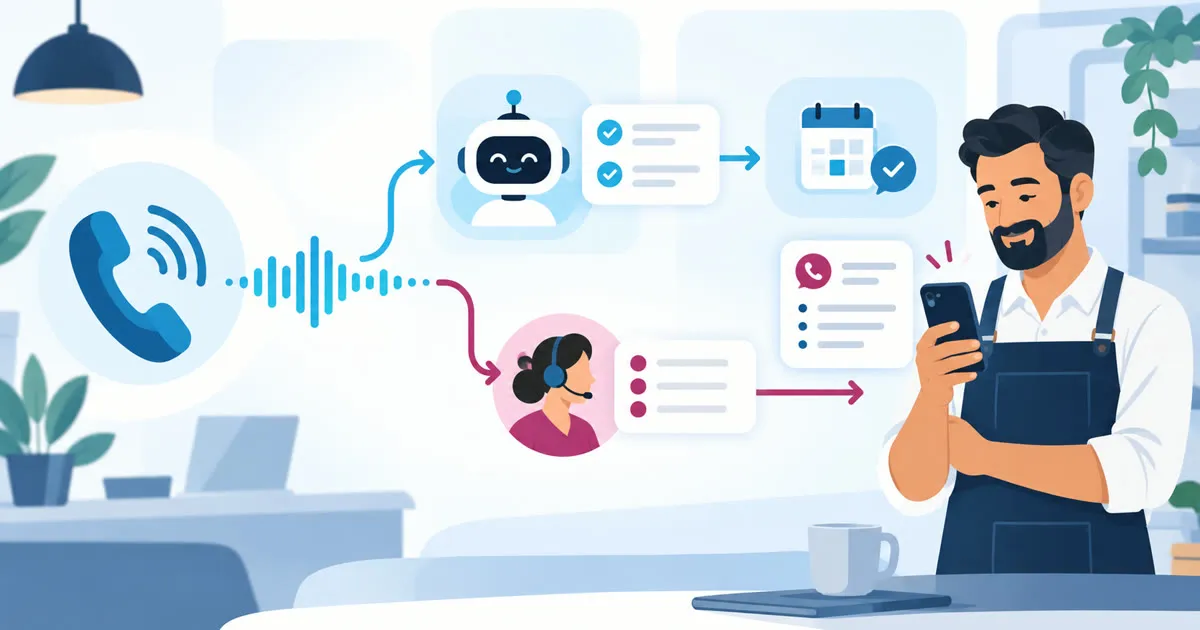
An AI receptionist should make it easier for a small business to respond to a caller, not give the caller a convincing dead end. That was the design problem behind No Missed Call, our AI receptionist for service businesses. It answers when the owner is busy, follows up by text, can route straightforward booking requests into the calendar, and gives the owner one place to see the call, message, and booking.
The part that deserved the most care was the handoff. A voice agent can sound polished and still fail the business if it records a vague message that nobody owns. The useful outcome is not “the AI had a conversation.” The useful outcome is that the caller either gets a confirmed next step or the right person receives enough context to take one.
That is the difference between an AI receptionist and a nicer voicemail box.
Start with the calls the system should not own
The first decision was deliberately unglamorous: do not ask the agent to handle every possible conversation. It should take the repetitive work that makes a phone line hard to cover while a small team is serving customers, driving between jobs, or already on another call.
For No Missed Call, that means a caller can get a prompt response, basic questions can be handled from the business information available to the system, and a routine booking request can move toward the calendar. The portfolio version also includes SMS follow-up, which matters because some callers will not stay on a call long enough to finish an intake or wait for a transfer.
The tradeoff is intentional. A narrow agent has to say “I will have someone follow up” more often than an agent that tries to improvise. That can feel less magical in a demo. In a real business, it is usually more trustworthy. A complex quote, an exception to a policy, an upset caller, or a request that needs judgment belongs with a person who has the authority to decide.
If a business wants a voice agent to do more, it can add scope over time. Starting with a short list of safe jobs makes it possible to test the result without making the phone line an experiment for every customer.
Make the handoff a record, not a promise
“We will have someone call you back” is only useful when the business can act on it. The handoff needs to carry the caller’s name or number when available, what they called about, what was already discussed, and the next action the caller expects.
That is why No Missed Call combines the call flow with SMS follow-up and an owner dashboard. A callback is not hidden inside a recording that someone has to remember to play. It becomes a visible item that can be checked, assigned, and closed out. The text message also gives the caller a way to continue the conversation without repeating every detail.
This is a practical distinction. A live transfer, a callback request, and a booked appointment are three different outcomes. They should not be reported as the same thing. The Intermedia AI Receptionist launch makes the same point in product terms: when a call escalates, the receiving person needs a recap of what was already discussed.
For a small team, the right handoff may not be a live transfer at all. If everyone is on jobs, routing a caller to a ringing phone just creates another missed call. A clear callback task plus a text confirmation can be the more honest path. The owner can then decide when to call back instead of discovering a half-finished conversation at the end of the day.
Booking is useful only when it is specific
Calendar integration is the other decision that looks simple from the outside. A system can offer a time slot only when it has a real calendar to check and a clear rule for what counts as a bookable job.
We built No Missed Call to turn straightforward conversations into scheduled jobs, not to force every caller into an appointment. That distinction protects both sides. The caller gets a real booking when the request fits the available service and schedule. The business avoids a calendar full of appointments that needed a quote, a specialist, or a human conversation first.
The same principle applies to information collection. Ask for the details that let the owner act next; do not turn a person calling about a broken air conditioner, a repair, or a service question into a long questionnaire. A short, useful handoff is better than a complete-looking record that nobody has time to read.
Test the awkward paths before the busy ones
The obvious test is a normal caller asking about hours or requesting an available time. It is also the least revealing test. The better test cases are the ones that expose whether the handoff design is real.
Try a caller who asks for a person immediately. Try a request outside the business’s normal service area. Try a booking request when the calendar has no suitable slot. Try a caller who says they already spoke with someone. Then check the dashboard and the text follow-up from the owner’s point of view: can they tell what happened and what they need to do without listening to the whole call?
These tests are not about trying to make the agent fail. They show where the business rules are missing. If a request cannot be handled automatically, the system needs a plain route to a person, not another loop of questions.
The owner still owns the relationship
No Missed Call is built for the gap between a customer calling and a small business being able to answer. It does not remove the owner from the relationship. It gives them a better starting point when they come back to it.
That is also when an AI receptionist is the wrong fit. If every inbound call requires deep advice, sensitive judgment, or a negotiation that only one person can have, the right investment may be better staffing or a clearer callback process rather than voice automation. The technology earns its place when it makes routine calls easier to resolve and makes the exceptions impossible to lose.
If you are deciding whether an AI receptionist belongs in your business, start by listing the calls you miss and the next action each one should produce. Then test the handoff before you worry about the greeting. You can see the No Missed Call build alongside our other projects on the US APP Team portfolio, or use the app brief to map out the workflow you need.
Your app. In the stores. Done for you. US APP Team designs, builds, and launches your iOS and Android app for a fixed price. Start your app brief or book a free intro call — both are free.
Want to poke around first? Every tool in our free tool library runs in your browser with no signup: an app cost calculator, an app name generator, and a privacy policy generator.
